> For the complete documentation index, see [llms.txt](https://tutorials.kuasa.io/getting-started/llms.txt). Markdown versions of documentation pages are available by appending `.md` to page URLs; this page is available as [Markdown](https://tutorials.kuasa.io/getting-started/kuasa-marketing-automation/marketing/how-to-use-marketing-automation.md).

# How To Use Marketing Automation

1. Login to your account via <https://marketing-automation.kuasa.io/>.
2. Click **Marketing Automation.**

<figure><img src="/files/m4A8doq1r0XgO72eViqL" alt=""><figcaption></figcaption></figure>

3. Click **Create an automation** button.

<figure><img src="/files/M3Gn55dhHRXAI8FLUFv5" alt=""><figcaption></figcaption></figure>

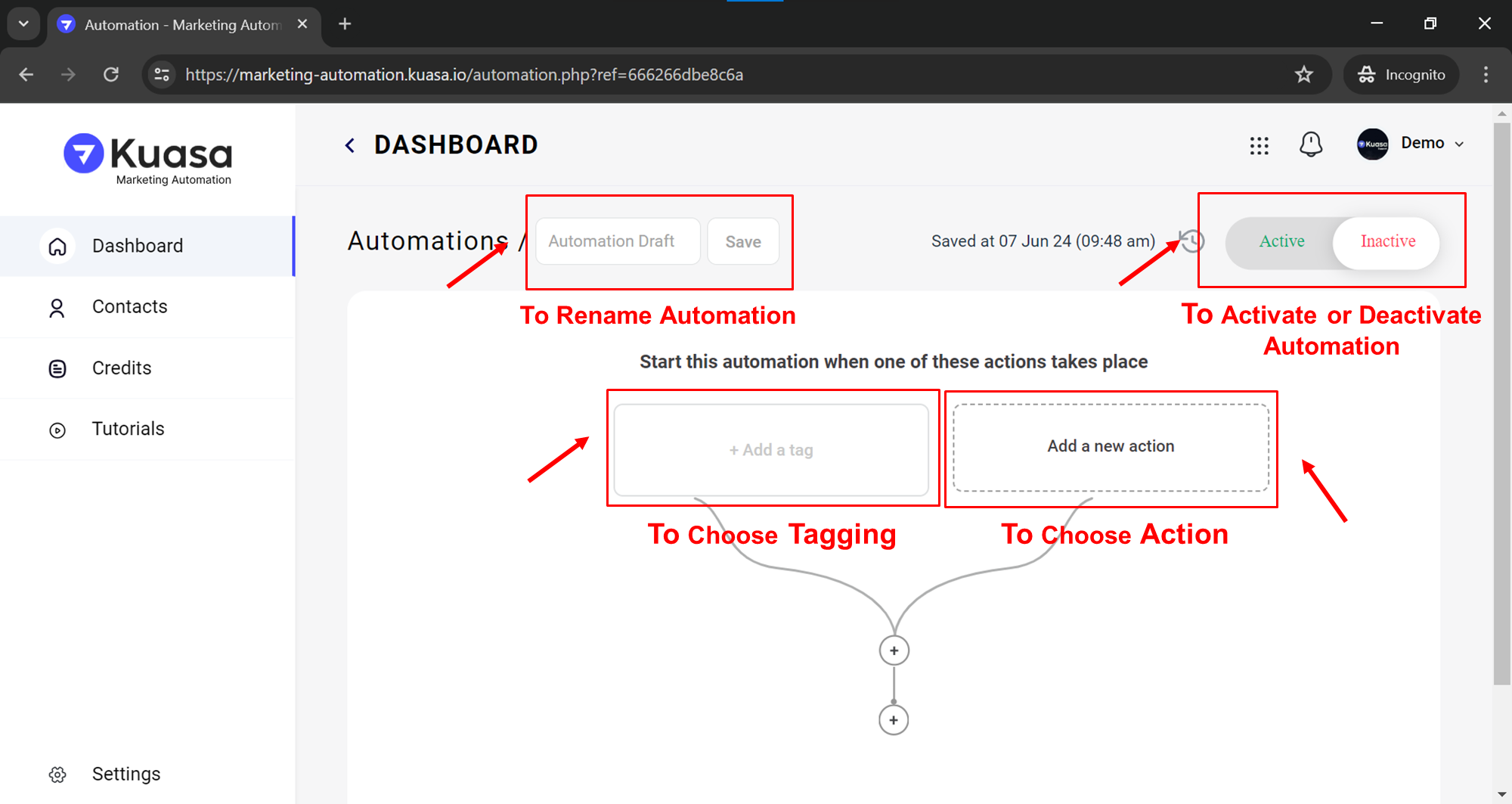
4. Fill in all the details needed such as **Automation Name**, **Add Tagging**, **Add Action** and **Automation Status**. Then, click **Add a new action** button as shown in the picture below.

<figure><img src="/files/KekOTiospvfSECTnk4q2" alt=""><figcaption></figcaption></figure>

5. In the **+ Add a Tag** section:

* Select the tag you want to use.
* To send a message to all existing leads under that tag, tick the checkbox and click **Get All Leads**.
* Click **Confirm** to proceed.

<figure><img src="/files/TYVMSUXw3CDlf5UCwjpC" alt=""><figcaption></figcaption></figure>

6. After adding the tag, you can add message automation by clicking **Add a New Action** and selecting the communication channel, such as **Email Automation**.

<figure><img src="/files/umqsz6N09vqWKZxrhjow" alt=""><figcaption></figcaption></figure>

{% hint style="info" %}
The opt-in form that the customer must fill out **MUST** match the selected tagging.
{% endhint %}

7. Write the **Subject** and content for your mesage of the email you want and add image.

<figure><img src="/files/BtpWbW4JhaJA67KXqSLE" alt=""><figcaption></figcaption></figure>

8. You can add more than one action in one automation. For example, you want to automatically send 2 emails to customers. First, the delay is only 1 minute. Second, the delay is 2 days after that. The way to add an action, follow steps 5 to 7.

<figure><img src="/files/1xIoSA8zalbIkn89MrtA" alt=""><figcaption></figcaption></figure>

9. Click the sequence as shown in the picture below

<figure><img src="/files/puqt6svB1M1CqX0YHuG3" alt=""><figcaption></figcaption></figure>

10. Click '**Select a Wait Condition**'.

<figure><img src="/files/sAQId4QZBZ0jJXhI68Bg" alt=""><figcaption></figcaption></figure>

11. Click '**Wait until specific conditions are met**' button.

<figure><img src="/files/okKeAMMXcW11EfwUfOUH" alt=""><figcaption></figcaption></figure>

12. Click the most left drop-down to select the condition.&#x20;

<mark style="color:blue;">**For example: Order Status**</mark>

<figure><img src="/files/kfqtSEoJ1k1eCcvrOaFD" alt=""><figcaption></figcaption></figure>

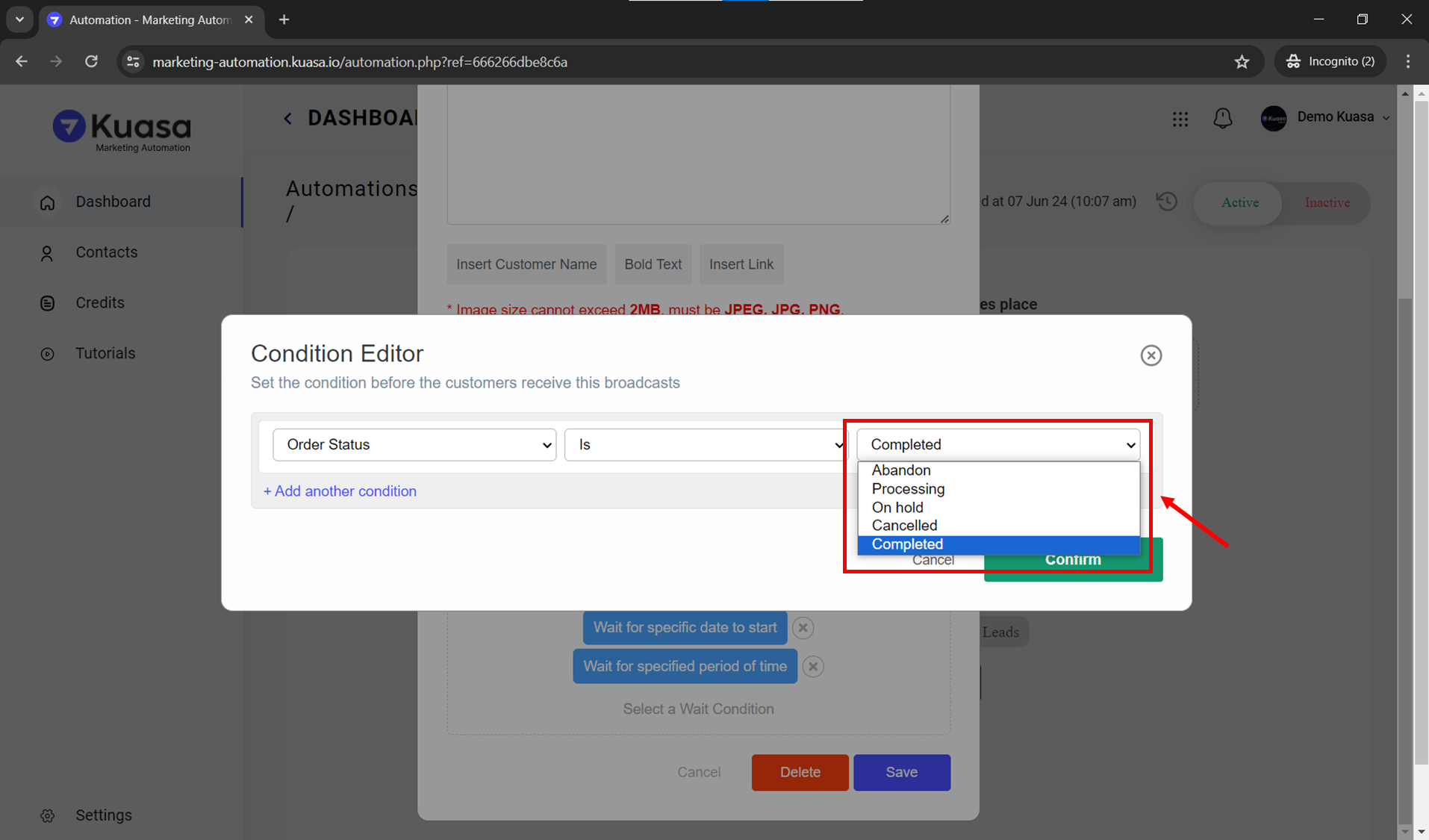
13. Click the most right drop-down to select the condition status.

<mark style="color:blue;">**For example: Completed**</mark>\ <mark style="background-color:blue;">**Marketing Automation will be running if customer order status is completed. You may change the condition based on your preferences.**</mark>

<figure><img src="/files/VY5Fq99OFer4MtQzvdcN" alt=""><figcaption></figcaption></figure>

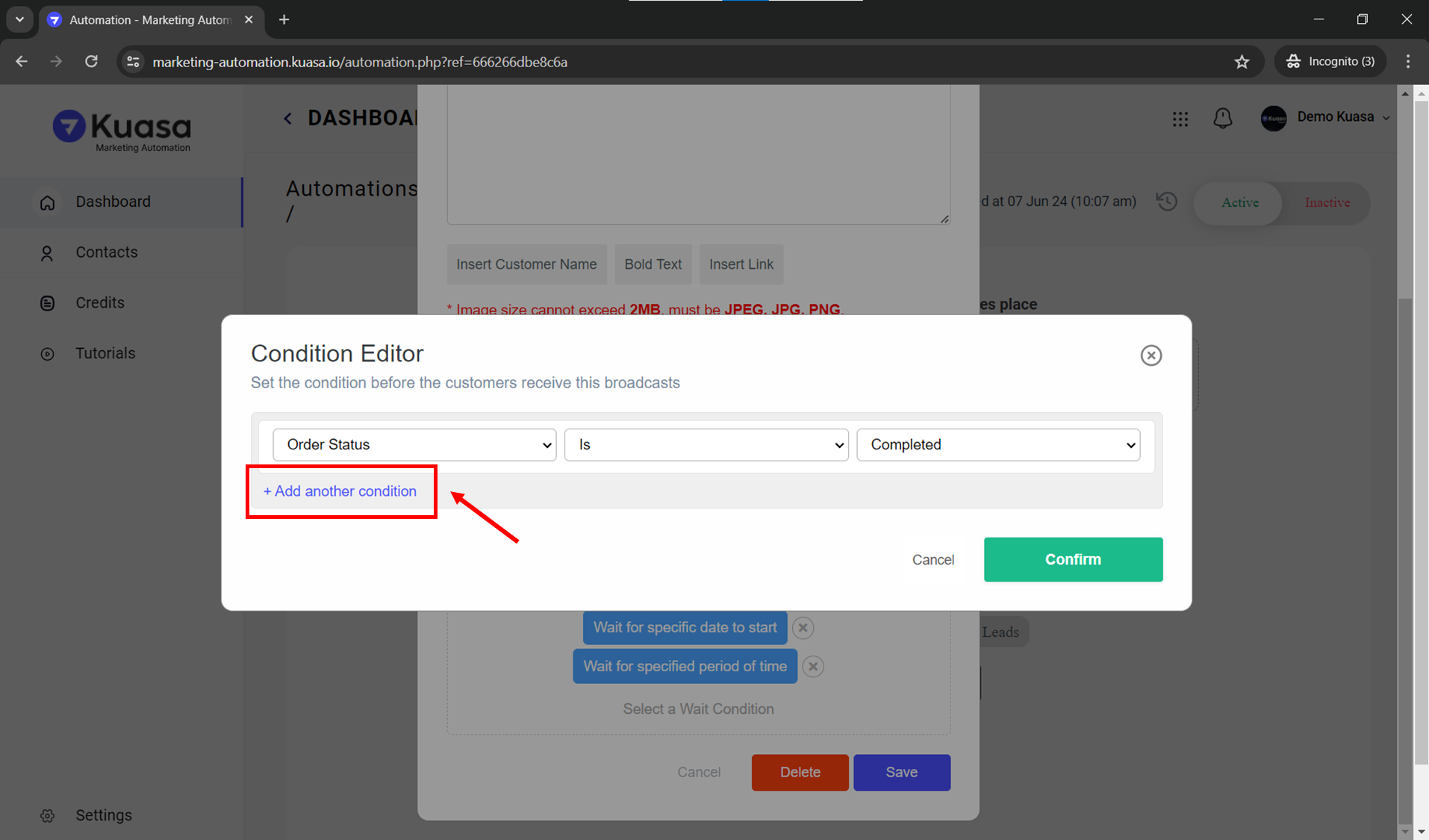
14. Click **+Add another condition** to add condition. <mark style="color:red;">**This step is optional.**</mark>

<figure><img src="/files/jnJskRlUAUQLPmr89FG4" alt=""><figcaption></figcaption></figure>

15. Select the condition you want to apply for the new condition as shown in the picture below.

<mark style="color:blue;">**For example: Order Date**</mark>

<figure><img src="/files/iUpuCavlsv6mc3lDn0r2" alt=""><figcaption></figcaption></figure>

16. Select the condition you want to apply for the new condition as shown in the picture below.

<mark style="color:blue;">**For example: is before**</mark>

<figure><img src="/files/9Ajk6oLZmZ14drbxb9Ti" alt=""><figcaption></figcaption></figure>

17. Select the condition you want to apply for the new condition as shown in the picture below.

<mark style="color:blue;">**For example: Date 12th July 2024**</mark>

<mark style="background-color:blue;">**The most right condition is based on the first condition chosen.**</mark>

<figure><img src="/files/eeAYkbPoZQMRlURUhzos" alt=""><figcaption></figcaption></figure>

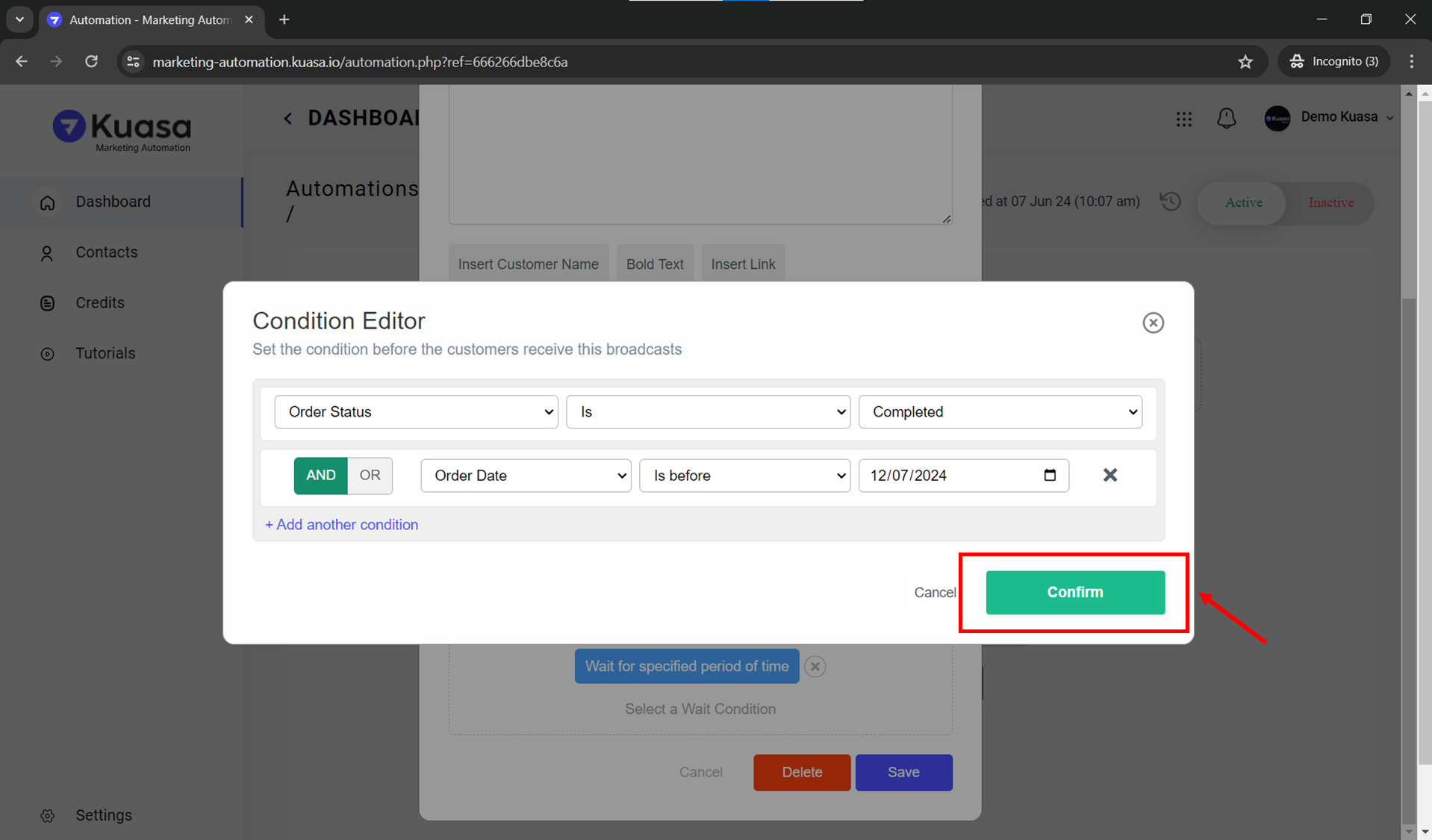
18. Click **Confirm** button to proceed with the automation.

<figure><img src="/files/oXXts9TX5ahTQ4Ls42HN" alt=""><figcaption></figcaption></figure>

19. Make sure your automation is in the **Active** section to make sure the automation is activated.

<figure><img src="/files/fb3G11J2L4DhQHb1xsSu" alt=""><figcaption></figcaption></figure>


---

# Agent Instructions
This documentation is published with GitBook. GitBook is the documentation platform designed so that both humans and AI agents can read, navigate, and reason over technical content effectively. Learn more at gitbook.com.

## Querying This Documentation
If you need additional information that is not directly available in this page, you can query the documentation dynamically by asking a question.

Perform an HTTP GET request on the current page URL with the `ask` query parameter:

```
GET https://tutorials.kuasa.io/getting-started/kuasa-marketing-automation/marketing/how-to-use-marketing-automation.md?ask=<question>
```

The question should be specific, self-contained, and written in natural language.
The response will contain a direct answer to the question and relevant excerpts and sources from the documentation.

Use this mechanism when the answer is not explicitly present in the current page, you need clarification or additional context, or you want to retrieve related documentation sections.